
Volkswagen betting big on CNG
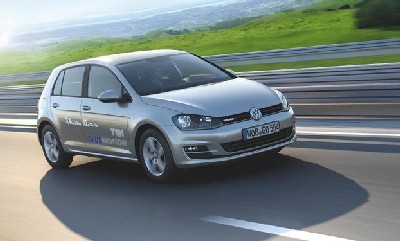
The VW Golf TGI BlueMotion can travel 420km on compressed natural gas and 940km on gasoline for a combined range of more than 1300km.
Three letters had a big effect on the world of engines at the end of the 1980s: TDI. Audi brought turbocharged diesel direct injection – TDI – into volume production in 1989 and it quickly became the gold standard for high-mileage drivers.
Volkswagen now wants to repeat Audi’s success, this time with TGI as the acronym. Those letters are for the automaker’s new bi-fuel models that can run on both compressed natural gas and gasoline.
A variant of the Golf is the first model to lose its EcoFuel badge in favor of a TGI BlueMotion logo. The Golf TGI BlueMotion arrived this summer and will be followed by a wagon derivative in the autumn.
The TGI is one more sign of the growing importance of CNG as an alternative fuel. Volkswagen is betting that CNG, with it comparatively low CO2 emissions, will successfully compete against other fuel options.
Niche market
VW Group already offers some of Europe’s top-selling natural gas models, however, it ranks a distant second to Fiat in the niche, largely because of strong demand for the powertrain in Italy, where 5.0 percent of all cars sold after five months used the fuel, according to JATO Dynamics.
Overall, automakers sold 36,618 CNG cars in Europe in the first five months, up from 29,901 during the same period last year, JATO figures show. That resulted in a market share of 0.7 percent, up from 0.5 percent.
Political influences are changing the outlook for natural gas. In Europe, China and the United States, support is building for the transition to natural gas. Due to its lower carbon content at a simultaneously higher fuel value, natural gas offers the opportunity to emit 25 percent less CO2 than conventional gasoline- or diesel-powered cars at identical driving performance.
Natural-gas vehicles also will be key to helping meet CEO Martin Winterkorn’s recent promise that VW Group will reduce its fleet CO2 emissions to 95 gram per kilometer by 2020.
The reasons are partly rooted in powerful economic factors: Saving a gram of CO2 with a CNG powertrain is many times less expensive than with the plug-in hybrids that are also under development. Also, while experts are forecasting a shortage of oil, they are not predicting a dearth of natural gas.
“The global resources are enough for at least 250 years,” said Wolfgang Warnecke, Shell’s top scientist.
Natural gas, however, poses risks to the environment from the loss of methane into the atmosphere. If unburned methane reaches the atmosphere, it has 25 times the greenhouse effect of carbon dioxide.
Model offensive
Volkswagen will offer at least one CNG version in each model line. The introduction of the modular transverse matrix (MQB) architecture created space for the range improvement.
As soon as the Passat and Polo are converted to the MQB with the next model changeover, each of their CNG models also will feature a larger gasoline tank. VW’s sibling brands, Audi, Skoda and Seat, also will offer natural gas vehicles in the future based on MQB’s underpinnings.
But only a few manufacturers, such as Fiat and Opel, are as dedicated to the niche as VW. Mercedes-Benz sells CNG-powered B- and E-class models while BMW has pulled out of the business.
Heinz-Jakob Neusser, VW’s top engine developer, understands why some automakers are reluctant to enter the niche. “Compared with the competition, we can allocate our development expenditures over higher volumes,” he said.
BMW development chief Herbert Diess confirmed the importance of higher volumes for the niche at the recent Vienna Motor Symposium. “As a small manufacturer, we don’t have the opportunity to change customer behavior.” VW should lead the way, he said. “Then we would follow – if it works.”


