
Smart will unveil new ForTwo, ForFour models next year
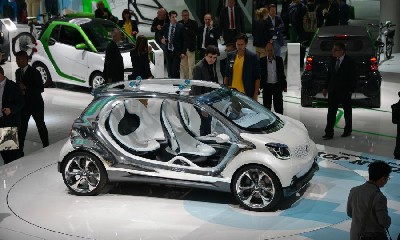
The Smart FourJoy concept, shown at Frankfurt, was a look at what Smart may be considering for future models.
Daimler’s Smart unit is subjecting its third-generation ForTwo model to the final phase of a three-year test and development program ahead of a planned unveiling next year.
The two-seater hatchback represents a fresh chapter in operations for Smart, which has recently gained greater independence from Daimler as its boss, Annette Winkler, attempts to stem years of financial losses after almost a decade of rebuilding following Smart’s short-lived joint venture with Mitsubishi.
The new ForTwo, known internally as project C453, has been developed in a joint engineering program with the upcoming second-generation ForFour and its sister car, the third-generation Renault Twingo.
All three are based around a newly-developed rear-engined/rear-wheel-drive platform structure with engineering led by Smart with input from Renault, which is relying upon it to provide next year’s third-generation Twingo with a new lease on life.
Conceived to support differing wheelbases and track widths, the new structure boasts more high-strength steel than is used in the 15-year-old, second-generation ForTwo. That adds rigidity and improves safety.
While Smart has joined forces with Renault to create greater economies of scale and share development costs, Winkler is adamant that the basic character and urban driving focus of the ForTwo remains intact. “It is a city car, and in this respect it is quite unique. We have successfully built on the strengths of the old model,” she said. “The new ForTwo is more mature in many respects but it still fun to drive.”
In a move driven by the latest pedestrian injury criteria applied to the European NCAP test procedure, the new ForTwo forgoes the one-box silhouette of its predecessor for a two-box profile, with a more defined hood and more upright windscreen.
Familiar features such as the ultra-short overhangs, exposed Tridion steel safety cell, two-piece tailgate, composite body panels and two-tone paint scheme are set to remain an integral part of the new car’s styling. New details such as the LED imbued head and tail lamps, a honeycomb grille insert and engine bay cooling ducts have been carried over from recent concept cars to give it a completely new look that will be shared with the new ForFour to provide the new Smart lineup with a distinctive family appearance.
The ForTwo coupe, as the two-door microcar is officially named, will be unveiled in June 2014 prior to making its first public appearance alongside the ForFour at the Paris auto show in September 2014. A successor to the ForTwo cabriolet is then due to make an appearance at the Geneva auto show in 2015.
The new ForTwo retains the same length as the current second-generation model. “After consultation with existing customers, we came to the conclusion that compactness is still central to the appeal of the car for the majority of customers. It is the key factor that sees the ForTwo stand out from the crowd,” said Winkler.
However, Smart has provided the latest version of the car with added body width. As well as providing the ForTwo with a more confident appearance, the added width within the body has provided scope for significant changes to the chassis. Insiders suggest the handling has been transformed, both at lower speeds around town and at higher speeds on the open road, with the larger footprint said to bring a dramatic improvement in the ForTwo’s ability to carry speed through corners, without the need for premature intervention from the stability control system.
A wider track is also claimed to bring added stability at higher speeds, particularly in lane change maneuvers.
The new ForTwo is powered by an all-new transverse, rear-mounted engine. The 1.0-liter three-cylinder direct-injection gasoline unit has been developed in partnership between Daimler and Renault. Two versions of the joint engineered powerplant are planned: naturally aspirated 70 hp and turbocharged 85 hp. A more highly tuned turbocharged 105 hp version will also appear as a successor to the ForTwo Brabus.
The new engine will come mated to a standard six-speed manual or optional seven-speed dual-clutch gearbox — the latter produced by Getrag and revealed at the recent Frankfurt auto show. As with the previous two generations of the ForTwo, drive is channeled to the rear wheels.
For the first time since its introduction back in 1998, the signature Smart model will go without a diesel engine option. “We investigated the development costs for a new diesel. But they were prohibitively high for the limited sales volumes we could have expected,” says Winkler.
Instead, Smart has concentrated its engineering efforts on a new electric drivetrain. Details remain scarce, but it is described as a development of the existing architecture used in the Smart ForTwo ED, which will continue to be produced alongside the new ForTwo.
The new ForTwo will be built in Smart’s factory in Hambach, France, with the first production examples due in May.
Joining the ForTwo in Smart’s new lineup in 2015 will be the all-new second-generation ForFour.
Essentially a stretched version of the ForTwo, with which it shares its complete front-end exterior styling and interior appointments, the new four-seater has been developed in a joint engineering program with the third-generation Renault Twingo, alongside which it will be produced in Nova Mesto, Slovenia.
Conceived to broaden Smart’s sales reach, the new ForFour runs to a length of 3500mm (137.8 inches), according Winkler, making it 805mm (31.7 inches) longer than the ForTwo but 251.4mm (9.9 inches) shorter than its Mitsubishi Colt based predecessor produced between 2003 and 2006.
As with its rivals, the Fiat 500 and Volkswagen Up, the new Smart model, codenamed W453, attempts to appeal to city dwelling family car buyers by offering two rear seats and stubby rear doors that open to almost 90 degrees to aid entry. The individual rear seats are simple affairs that can easily be flipped to form a bench and extend luggage capacity.
The ForFour will be sold with the same engine as the ForTwo, a turbocharged 1.0-liter three-cylinder gasoline engine, together with an electric drivetrain developed in partnership with Tesla.


