
Opel to cut CO2 by 27% with new powertrains
General Motors subsidiary Opel/Vauxhall says new powertrains will cut its average CO2 output 27 percent by 2020, helping the automaker comply with tougher EU emissions regulations.
With 13 new engines, Opel will renew 80 percent of its engine portfolio between 2012 and 2016. It also will add new transmissions. The renewal begins this year with new 1.6-liter gasoline and diesel engines, along with new five- six- and eight-speed gearboxes.
“Europe will continue be the place that pushes the leading edge of CO2 technology. We intend to stay at that leading edge,” Mike Ableson, Opel’s board member responsible for engineering, told journalists at Opel’s proving ground here, near Frankfurt.
Opel/Vauxhall didn’t give its current fleet CO2 total, but figures from market researcher JATO Dynamics show the company’s 2012 average fleet emissions were 132.8 grams per kilometer. That means a 27 percent cut would drop the automaker’s average to 97g/km.
By 2020, European regulators want the CO2 average for all automakers to be 95g/km, down from 130g/km in 2015. In 2012, the fleet average was 132.3g/km, according to JATO.
GM announced last month it would invest 4 billion euro in Opel/Vauxhall through 2016 to help the automaker launch 23 new models along with the new engines by 2016.
Ableson said the investment will include five versions of a small-displacement gasoline engine family.
The smallest member of this family is a 1.0-liter three-cylinder gasoline turbo unit that will appear first in the Adam minicar next year. The biggest will be a 1.5-liter four-cylinder unit and the most powerful a 1.4-liter turbo. No power outputs have been given yet.
The engines were designed with input from GM’s China partner, Shanghai Automotive Industry Corp., and will be built in Szentgotthard, Hungary.
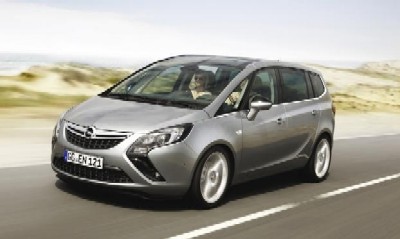
In the same factory, Opel will produce three versions of its new 1.6-liter diesel, which was developed in-house. The engine debuts next month in the Zafira Tourer minivan. Fitted with the mid-range 136-hp version of the new engine, the car’s CO2 emissions will be 109g/km resulting in a fuel use of 4.1 liters per 100km. By comparison, CO2 output is 119g/km in the Zafira Tourer’s comparably powered 2-0-liter diesel.
A 95-hp version and a twin-turbo 160-hp variant also will be produced. Together the family of 1.6-liter diesels will replace the 1.7-liter as well as lower-powered versions of the 2.0-liter units currently used in Opel/Vauxhall models. Some versions of the 2.0-liters will continue to be used.
“We continue to recognize diesel as the most important powertrain technology in Europe,” Ableson said. “We are bringing most of it in-house, which is somewhat different from what we have done in the past.”
He didn’t say whether the company would continue to take Fiat’s 1.3-liter diesel. Industry sources expect that powerplant to be replaced by an engine developed by Opel’s alliance partner PSA/Peugeot-Citroen.
Two new 1.6-liter turbocharged gasoline engines with outputs of 170 hp and 200 hp will be built on the same line as the 1.6-liter diesel in Hungary.
A company source told Automotive News Europe that both gasoline engines, as well as a naturally aspirated 1.8-liter gasoline unit from the same family, will be fitted to GM cars sold in the United States. The 170-hp version is already available in the new Opel/Vauxhall Cascada convertible.
Opel said the 1.6-liter gasoline and diesel engines could be hybridized, but engineers at the automaker previously told Automotive News Europe the company doesn’t need to add electrification to the powertrains to reach the 95g/km average in 2020.
Rounding out the 13 new engines, Opel/Vauxhall will update its current 2.0-liter engines, one gasoline and two diesels.
Opel also announced new transmissions, including an eight-speed automatic that can be fitted to both gasoline and diesel models. The automaker said the eight-speed gearbox improved fuel consumption by 3.6 percent compared with the six-speed automatic currently used in the Insignia mid-sized range. No timing was given on the new transmission’s launch.


