
One of one: unique 1,000hp Lotec Mercedes supercar for sale
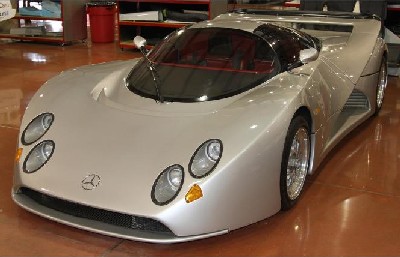
Think the 1,000hp Bugatti Veyron was groundbreaking? What if we told you there was a Mercedes-Benz supercar with the same power output back in 1995 – a decade earlier than the Bugatti – and one that also claimed a higher top speed?
Meet the Lotec C1000.
The chances are, you’ve never heard of Lotec or the C1000 before. That’s because there is literally only one in existence. And that’s because the car was commissioned by an individual from the United Arab Emirates.
Although it’s not clear, the chances are he was pretty successful in the oil business, because in the early 1990s he approached the Germans asking them to build him the fastest car in the world. He wanted something so cutting-edge it would be years before anyone else caught up. The Lotec C1000 is the result.
Thanks to the fog of history, it’s also unclear whether the mystery man approached Mercedes or Lotec directly, but Lotec certainly did the majority of the work. This little-known German firm was founded in 1962, started building racing cars in 1969 and expanded into modifying Mercedes and other exotics in 1983.
The C1000 was completed in 1995. And it really was unlike anything the world had ever seen.
The prominent Mercedes badge on the front is justified by the engine (at the very least, as we’ll see in a moment). This is a twin-turbocharged 5.6-litre V8 related to the 5.0-litre units used in the Sauber Mercedes Group C prototype racing cars that tore up endurance events such as Le Mans in the late 1980s and early 1990s.
Lotec (or Mercedes…) did quite a lot of work on the motor, boring it out by an extra 600cc, and fitting different turbochargers. Officially, Lotec claims 850hp and 722lb ft of torque, but there’s a widely held belief that it actually produced 1,000hp. Hence the C1000 name.
That 1,000hp figure is hardly unbelievable, since the racing cars pushed 950hp on a routine basis – in fact the Sauber Mercedes C9 is one of the fastest cars ever recorded on the Mulsanne Straight at Le Mans, reaching 248mph in qualifying in 1989.
With no racing rules to conform to, Lotec was able to focus on the C1000’s aerodynamics to an even greater extent – and as a result, claimed the top speed was 268mph. The 1,200hp Veyron Super Sport averaged 267mph on its world record-setting run (though it did reach nearly 270mph in one direction).
With 0-62mph taking just 2.5 seconds, the Veyron Super Sport is comfortably faster in terms of acceleration – helped by modern tyre technology and four-wheel drive.
But the rear-wheel-drive-only Lotec C1000 still manages 0-62mph in an incredible 3.2 seconds, with 0-124mph taking 8.1 seconds. The former matches the seminal McLaren F1, the latter beats it by a whole 1.3 seconds. The C1000 is seriously fast.
Part of the secret to this sensational performance is in the Lotec’s all-carbonfibre construction – from the bodywork to the underlying monocoque chassis, everything is made from the wonderous weave.
As a result the C1000 weighs in at 1,080kg. Which is about the same as a Ford Fiesta.
All of which makes you wonder how on earth Lotec was able to build such a high-tech road car back in 1995. Well, no doubt the company’s background in racing car engineering helped – but there may be an even more straightforward explanation.
Looking at pictures of those contemporary Sauber Mercedes – the gullwing doors, the enormous width of the sills, the unusual position of the gear-level for the Hewland manual transmission – could it be that Lotec converted one of these for road use and added its own bodywork?
This is apparently unconfirmed, but it would have been a brilliant way of going about this project. There are various road-going versions of the Porsche 962 Le Mans racer, after all.
However Lotec and Mercedes did it, the project absolutely definitely cost millions of dollars – perhaps as much as $3.4 million. Back in 1995.
Today that’s equivalent to around $5.4 million, which is in turn around £3.4 million.
Now the Lotec C1000 is up for sale again, this time at the RKM Collector Car Auction that’s taking place at the Charlotte Convention Center in North Carolina on 31 October to 3 November 2013.
The estimate is $1 million to $1.1 million – or about £619,000 to £681,000. Arguably that actually makes it a bit of a bargain.


