
New technologies for a mobile society

Here are some new technology items to make your life a little easier and safer. These days, manufacturers are packing more and more technology into smaller and smaller gadgets.
Thanks to Gordon Moore, you’ll likely find yourself on the trail with more processing power than NORAD wielded a few years ago. But is more always better?
Here are examples of gear that are pushing the boundaries so far they beg the question: when does technology go from a boon to a distraction?
Shimano Di2 Electric Shifters
On July 1, Shimano announced the latest version of their Di2 electric shifters, the Ultergra 6870.
Though electric shifters rank high on the “why would you need this?” scale, they do offer some advantages. Primarily, it’s about precision — tap the shifter and it knows exactly where to situate the chain, though the new version even drops weight over comparable cable shifters. The front derailleur will microadjust to avoid rubbing when the chain crosses several gears, and it can also shift the front and back at the same time. But these have been hashed out.
As The Cycle Life points out, the next-generation Di2s make a different important technological step: they come with programmable software, including firmware updates. Because it’s programmable, there’s also the opportunity to expand the hardware, adding shift buttons to other spots besides the hoods.

ZBoard Motorized Skateboard
A Kickstarter success story, the ZBoard exceeded its $10,000 goal by a factor of nearly 30. One thing the board does right is it gets the technology out of your way. The user interface is simple: lean, and it goes — up to 18 miles per hour. Though the manufacturer does not recommend using the ZBoard for tricks, it’s suited well to commuters, with a 400 watt electric motor and a range up to 10 miles. So while the board features some smart technology, with regenerative braking and force-sensing foot pads, its simplicity sets an example for other gear: let the machine do the thinking.

Recon Jet
Last month, Recon (makers of the MOD Live heads-up-display for ski and snowboard goggles) released Jet, a wearable HUD targeted at cyclists. It’s wireless (ANT+ and Bluetooth) and bulky, and attached to a pair of sunglasses. It’s like Google Glass for speed freaks, and it will certainly be fraught with some of the same privacy issues, thanks to its HD camera.
But with Jet, Recon one-ups even Shimano’s programmable Di2: It’s built on an open platform, allowing developers to build apps to go along with it, expanding its basic capabilities however they see fit. But at least for now, with integrated polarized lenses, Jet could be limited by its own hardware — it’s only available as a complete unit, meaning you can’t pair it with your favorite shades.
LifeBEAM Heart-Rate Helmet
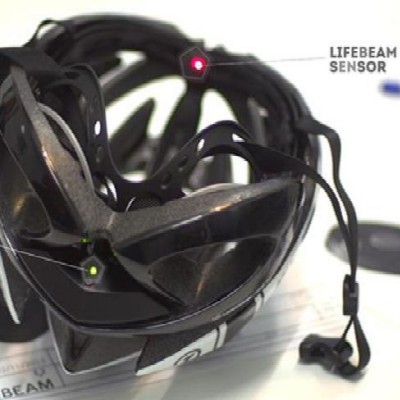
Wearing a bicycle helmet is generally considered smart. But you don’t usually think of the helmet itself as smart. LifeBEAM partnered with Lazer to make a connected helmet, and named the product “SMART.”
What the helmet offers is an alternative to chest strap heart rate monitors, substituting an optical sensor that reads a rider’s pulse through his or her skin. An integrated accelerometer offers possible future features like crash detection, and the whole system syncs to apps via Bluetooth or ANT+. Though it’s still only in production, LifeBEAM found enough believers to run a successful Indiegogo campaign, suggesting that the crowd, at least, welcomes this tech.

WaveJet Motorized Surfboard
Tow-in surfing revolutionized big-wave surfing. The WaveJet won’t — it only goes 7 miles per hour, not enough to catch really big curls. But then, it’s not always about the gnarly stuff. The WaveJet can replace some Jet Skis, or be used as a lifesaving device. A wrist strap controls the propulsion, which is powered by a modular, battery-driven pod with a pair of jets.
But controversy over the WaveJet’s use belies another issue with high-tech outdoor products; it’s not just the user who can have their experience altered by a little technology.

DJI Innovations Phantom Drone
With the increasing popularity of airborne drones, riders, shredders, climbers, and all kinds of athletes have a whole new way to record their exploits. They’re taking both amateur and professional video, and dropping in price while increasing in usability. Software (often open-source) is helping stabilize these flying machines, making the video better as well as making them easier to pilot.
DJI Innovations’ Phantom takes an important next step, offering a drone that’s out-of-the-box ready, with a mount for the ubiquitous GoPro. The four rotors are controlled by a GPS-based autopilot system, and unlike the skeletal metal designs of most drones, it comes preassembled. But the most important feature, of course, is the ability to send it where you can’t go.


