
Merkel warns EU against tough CO2 targets for carmakers
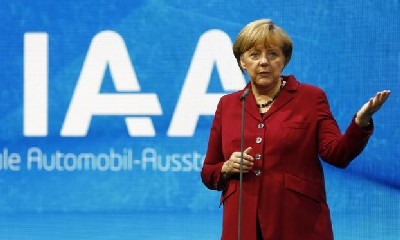
Photo credit: Reuters
German Chancellor Angela Merkel, facing elections in less than two weeks, warned the EU against imposing tough environmental targets on German luxury carmakers. Merkel, speaking at the Frankfurt auto show on Thursday, blocked a deal in June that would have set Europe’s car industry an ambitious target to reduce CO2 emissions.
She used a visit to the Frankfurt auto show on Thursday to say the measures could harm innovation and economic growth.
Merkel, tipped to win a third term as chancellor in voting on Sept. 22, blocked a deal in June that would have set Europe’s car industry an ambitious target to reduce CO2 emissions to 95 grams per kilometer by 2020 from an 132.4g/km last year.
“Europe must learn that we are not an isolated continent but that we must succeed in global competition,” she told a packed hall at the Frankfurt show. “We need to look beyond our borders — push for open and free trade, but at the same time not impose greater burdens on our industry than other continents do with their own industry.”
Thanking Merkel for her support, the head of Germany’s VDA auto industry association which includes luxury brands BMW, Mercedes-Benz and Audi, criticized EU officials for increasing the burden of regulation.
“Lawyers and bureaucrats have to listen to the engineers with their technical know-how. The automotive industry will not make a good political pawn to be tossed between officials’ desks in Brussels,” Matthias Wissmann said.
However, a new German scientific study published on Thursday said the real threat to global economic growth came from continued delays in tackling climate change.
If the stalemate on international climate policy continued until 2030, it could cut up to 7 percent off growth worldwide within the first decade after the policies took effect, said the study by the Potsdam Institute for Climate Impact Research.
This is because cuts in greenhouse gas emissions would have to be even deeper and therefore more costly in due course to keep rising temperatures below an agreed U.N. ceiling of 2 degrees Celsius (3.6 Fahrenheit) above pre-industrial times, it said.
But if an agreement were to be achieved by 2015, as planned, global economic growth would only be 2 percent lower in the decade after the policies were implemented, the study said.
Separately, on Monday the European Federation for Transport and Environment (T&E) said automakers will have no trouble reducing overall fleet CO2 to 95g/km by 2020.
Diplomats have suggested Germany wants to delay the new EU deal on stricter CO2 emission rules for new cars until after this month’s election. Other sources in Brussels have said Germany wants to overturn the deal, not just delay it.
Merkel said car industry innovation showed up in the luxury market before trickling down to smaller cars.
The auto industry contributes a third of all German domestic spending on research and development and lifts the country’s r&d spending toward Merkel’s target of 3 percent of economic output, though that still lags the 4 percent of South Korea.
South Korea’s Hyundai and Kia have become two of the fastest-growing brands in Europe, causing trouble especially for Volkswagen and General Motors’ Opel.
Merkel praised Germany’s carmakers for combining classical engineering strengths with the current trend toward a digital world to create the connected car — a vehicle that can communicate with its environment and other cars to reduce accidents, lower carbon emissions and boost productivity.
“This is a chance for Germany to catch up in those areas of digitalization where we don’t play a leading role,” she said.
Daimler’s Mercedes-Benz brand aims to launch a self-driving car by 2020.
Daimler CEO Dieter Zetsche, who sat next to Merkel at Thursday’s official opening ceremony for the car show, has a particularly long way to go to meet the proposed EU targets.
Mercedes would have to reduce its fleet carbon emissions by 31 percent to 99 grams of CO2 per kilometer by 2020 from last year’s 143.6g/km, forcing the company to invest billions of euros in reducing the carbon footprint of its large, heavy luxury sedans.
One way the German luxury brands, which support from Merkel, want to reduce their fleet CO2 levels is with supercredits, which allow electric cars and plug-in hybrids to provide an even greater reduction in average emissions.
Since last year supercredits have been available for low-carbon cars. Each new car sold with tested CO2 emissions of 50g/km or below is now counted 3.5 times toward the manufacturer’s average for that year.
T&E says that supercredits create “fictitious emissions reductions only created through an accounting trick.”
The CO2 agreement reached between the European Commission, Parliament and Council capped supercredits in 2020 at 2.5g/km in any year per manufacturer and set the 2020 multiplier at 2.0 instead of 3.5.
“Deviation from this position, as advocated by Germany which is seeking to block the agreement, could significantly weaken the 95g/km 2020 target,” T&E said in its report.
At the show, Mercedes debuted a plug-in hybrid version of its S-class flagship sedan, which can drive about 30km on electricity alone. This allows it to emit just 69g/km, compared to the roughly 240g/km emitted by the high-performance AMG version with its 5.5-liter V-8 engine.
“To be very clear, we will meet the target,” Daimler development chief Thomas Weber told Reuters.


