
How GPM rebuilt itself into a PACE Award winner
When the Berlin Wall fell in East Germany, supplier VEB GPM endured the ultimate shock therapy. “In 1990, the East German auto market completely collapsed,” remembers Andreas Schmidt, grandson of the company’s founder.
Since operating as a nationalized East German company, GPM has become a global parts maker, with a NAFTA zone factory planned in the next year or so.
Almost overnight, the West German VW Golf and Opel Kadett models were available in the former East Germany, and East German vehicles were hardly salable. As a result, GPM cut about 100 employees, bringing its work force to 160.
The obvious solution for GPM was to find orders at established global automakers. But after decades in East Germany, the company had out-of-date production machinery and an aging factory.
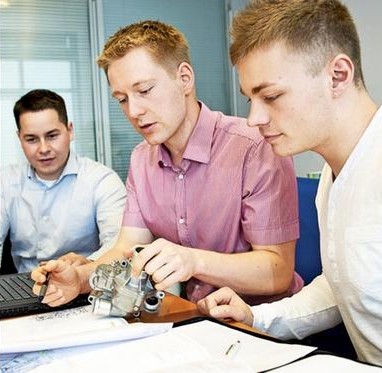
GPM did maintain keys to a successful future: a strong development department with well-trained designers, test engineers and prototype builders.
Water-pump technology
Armed with these assets, and innovative water-pump technology, GPM accomplished an astonishing comeback.
It now has operations in North and South America and China. The work force is above 1,000, and in 2012 it won an Automotive News PACE award for supplier innovation.
Through its history, GPM GmbH remained loyal to the tiny village of Merbelsrod in the German state of Thuringen.
Engineer Karl Schmidt established the company in 1939 to produce precision aircraft parts. He plunged into the production and repair of water pumps for aircraft in 1949 and later became a regular production supplier of coolant pumps.
His customers included Horch-werke AG, which was established by Audi founder August Horch and then later nationalized. The company also supplied the Eisenach auto factory. As a result, these pumps made their way into East German Trabant and Wartburg vehicles. Its products also were used in Moskvitch and Lada vehicles in Russia.
By the time of its nationalization in 1972 as VEB GPM, the work force had grown to about 250.
But its sheltered existence ended when the communism fell. After the reunification of West and East Germany and the collapse of the East German auto industry, the German government worked to privatize struggling companies in the east.
Eugen Schmidt, the son of the company’s founder, became managing partner of the privatized company, now known as GPM GmbH.
During the East German period, the company had built specialty water pumps for the West German auto industry on a sporadic basis, such as for motorsports. But it had no regular production orders.
Grandson Andreas Schmidt, who is now managing partner, says it took GPM “about two years to get its first order from a West German automaker.”
The company’s big break came when VW turned to GPM for water pumps for its replacement part business. As a result, GPM designed water pumps for all kinds of water cooled internal combustion engines, Andreas Schmidt says.
In 2001, the main factory in Merbelsrod underwent a significant expansion. And since automakers increasingly pushed to have their factories on other continents supplied with locally produced pumps, GPM build its first facility abroad in Indaiatuba, Brazil, in 2001.
In 2008, its subsidiary GPM Automotive Pumps Suzhou opened for business in China, and GPM North America Corp. was launched as a sales organization in a Detroit suburb.
The company has 30 staffers building water and oil pumps in Brazil, and 80 in China. A factory in the NAFTA zone is planned in the next year or so.
An expansion of GPM’s product lines has largely made the growth possible. For example, GPM development engineers were designing variable water and oil pumps right after 2000.
Regular production of these water pumps began in 2008. The first-generation pump used pneumatic pressure to stop or slow coolant flow when the engine is cold. This allows an engine to warm up quickly, reducing emissions and improving fuel economy.
GPM received a 2013 Automotive News PACE Award for its second generation of variable water pumps, which use an electronically controlled hydraulic piston inside the pump. As the engine’s temperature increases, the piston opens gradually, circulating more coolant through the engine.
The electrohydraulic pumps improve volume flow regulation, reduce installation space and lower system costs compared with the pneumatically controlled pumps, Schmidt says.
The new pumps went into production for Volkswagen Group in 2012. GPM added oil pumps to its product line three years ago.
In the years since the economic crisis of 2008, the company has experienced a growth spurt. Its revenue and the size of its work force doubled within five years. In 2013, about 1,040 employees are expected to generate about 270 million euros, or about $356.8 million, in revenue.
In five years, the company is planning to integrate a third foreign facility for water and oil pumps, this time in the NAFTA region. The group is setting its sights on revenues far exceeding $396 million.
Says Andreas Schmidt: “Not least of all, our variable water pumps have facilitated this growth in revenue. GPM will also continue to grow over the next few years, although not at this rapid pace but somewhat more slowly and steadily.”


