
German carmakers renew U.S. diesel push
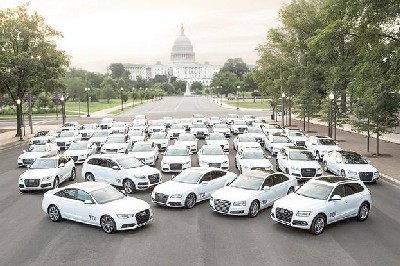
For years, BMW, Mercedes-Benz and Volkswagen Group sang the praises of diesel in the United States as a lonely trio.
They had little success changing U.S. laws to suit fuel-efficient diesels, even as hybrids and EVs found special treatment in the form of tax incentives, unfettered access to high-occupancy vehicle lanes and preferred spaces in private parking lots.
But now that other car companies are launching diesel-fueled versions of nameplates such as the Chevrolet Cruze sedan, Jeep Grand Cherokee SUV and Nissan Titan pickup, the German brands hope to find strong new allies in their push to make the United States friendlier to diesel, which boosts the fuel economy of a vehicle by about 30 percent.
“I’m hoping that their entrance gets attention not just with the car-buying public, but with policymakers,” said Anna Schneider, head of industry-government relations at Volkswagen Group of America, in an interview. The policymakers, she said, need to see that diesel is “not just a German thing — it’s a global thing.”
Companies such as VW are going state by state to stop diesel from being taxed at a higher rate than gasoline, a gap that stems from the fact that in the United States diesel is primarily a fuel for heavy trucks that do more damage to roads.
Schneider said the next target is Connecticut, which has the highest diesel tax in the country at 54.9 cents per gallon, 5.6 cents higher than the gasoline tax.
“Some states are going to realize there is an advantage to increasing the diesel fleet,” says William Woebkenberg, fuels policy director for Mercedes-Benz USA. But for now, he added, “it certainly is not a level playing field.”
Diesel would have an easier time in the United States if the Detroit 3 threw their clout behind it. It could happen, but probably not unless their diesel models start selling like very well, says Bruce Belzowski, an assistant research scientist at the University of Michigan Transportation Research Institute.
“For now, they’ll probably stick with gasoline and hybrids,” Belzowski says. “As they roll out more diesels and it becomes a bigger part of their mix, they might be more willing to argue for a diesel subsidy of some sort.”
By challenging gasoline’s supremacy in the United States, the Germans are up against an old trend: Governments tend to favor vehicles in which local manufacturers specialize.
In the United States, Detroit automakers defend rules that are tailored to the U.S. market, such as flex-fuel incentives. Japan uses taxes to prop up sales of minicars called Kei cars, which saves fuel — and protects a segment dominated by Japanese brands.
And across continental Europe, gasoline is generally taxed at a higher rate than diesel, so car buyers tend to pay a premium for gasoline at the pump.
That cuts petroleum use, but it also has helped keep thrifty gasoline hybrids from cracking the market. Still, the disparity remains, reflecting the power wielded by Europe’s largest automakers — not just the Germans, but also the diesel specialists at PSA/Peugeot-Citroen.
“In Europe,” Belzowski says, “the hybrid folks argue that they’re the ones being discriminated against.”
More automakers are selling diesels to Americans, but U.S. laws still favor cars with batteries — and even gasoline.
The federal diesel tax is 24.4 cents per gallon, 6 cents higher than the gasoline tax. State and local taxes average 31.1 cents for gasoline and 30.3 cents for diesel, so the average driver will pay about 5 cents of extra taxes for a gallon of diesel.
Buyers of plug-in hybrids and electric vehicles get a federal tax credit of as much as $7,500. Diesel vehicles were briefly eligible, with cars such as the BMW X5 getting as much as $1,800 in credits, but Congress let those credits expire in 2010.
Many states allow EVs and hybrids into HOV lanes even if there’s only one person in the car. But under an EPA rule, diesels are not allowed. That means the Mercedes-Benz E400 Hybrid sedan is eligible for Virginia’s “clean special fuel” license plates, but the Mercedes GLK250 diesel SUV — which promises better fuel economy — is not.


