
Ford studies effect of different ethanol blend levels on FFV emissions
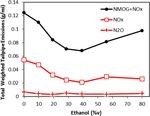
A team at Ford’s Research and Innovation Center in Dearborn conducted a detailed study of the effect of ethanol blend level in emissions, using a 2006 model Mercury Grand Marquis flexible fuel vehicle (FFV) operating on E0, E10, E20, E30, E40, E55, and E80 on a chassis dynamometer.
The study thus included the current predominant market fuel (E10); a range of possible future midlevel ethanol blends (E20 – E40); and the new range for high-level ethanol blends (E55, E80).
The number of blends they studied is about twice that of previous studies, and delivers a more detailed picture of the effect of ethanol blend level on emissions. Further, they reported data for engine-out emissions and tailpipe emissions; operating temperatures (engine-out and catalyst); and ethanol concentrations used in the engine control strategy. Comparing these data allows for differentiation between fuel chemistry and engine calibration effects—the two general mechanisms by which increased ethanol content in fuel affects the emissions.
Broadly, with increasing ethanol content in the fuel, they found that the tailpipe emissions of ethanol, acetaldehyde, formaldehyde, methane, and ammonia increased; NOx and NMHC decreased; while CO, ethene, and N2O emissions were not discernibly affected.
NMOG and THC emissions displayed a pronounced minimum with midlevel (E20–E40) ethanol blends; 25–35% lower than for E0 or E80. Emissions of NOx decreased by approximately 50% as the ethanol content increased from E0 to E30–E40, with no further decrease seen with E55 or E80.
The chemistry of a fuel impacts the emissions from an engine, with the most obvious example being unburned or partially burned fuel which is a major component of engine exhaust. Engine-out exhaust contains typically 1- 3% unburned or partially burned organic fuel components. The emissions control system then removes 95?99% of these organic compounds.23
The general trend of increased ethanol and acetaldehyde emissions, and decreased NMHC emissions, with increased ethanol blend level is expected based on the dominant role of fuel chemistry in determining the tailpipe emissions of these species—e.g., via the unburned or partially burned fuel which is a major component of engine exhaust.
Comparison of the NOx data shows the dominant role of engine calibration on the tailpipe emissions of NOx. Upon sensing greater ethanol content in the fuel, the calibration prescribed different engine operating conditions that yielded higher engine-out and catalyst temperatures during the critical cold-start period, which improved the NOx conversion efficiency of the exhaust after-treatment system.
There is a pronounced minimum of THC and NMOG emissions for midlevel blends reflecting the combined impact of fuel chemistry and engine calibration effects.
Ozone reduction in highly polluted urban areas generally requires reduction of the emissions of both NOx and organic compounds, the Ford team noted. Irrespective of ethanol blend level, the effect of increasingly stringent emission standards and vehicle fleet turnover is that emissions of NOx and NMOG from the on-road FFV fleet will continue to decrease substantially in the future.


