
Audi’s aim to top BMW at risk without new technology
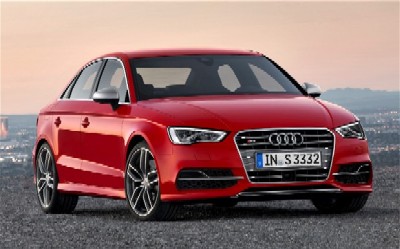
Audi has used Vorsprung durch Technik — German for advancement through technology — as its slogan since the 1970s. But signs are growing that the Volkswagen Group subsidiary is losing sight of its own advice.
Spending on r&d by the 81-year-old brand, VW Group’s profit engine, last year was far below the amount spent by both BMW and Mercedes-Benz owner Daimler.
While BMW trumpets its new i series for electric cars and Mercedes wins positive reviews for its new CLA and GLA ranges of sporty compact models, Audi risks looking like a laggard in an industry where innovation is a major draw for customers.
“I’ve grown tired of that single-frame grille,” said Stefan Reimann, a 47-year-old public relations manager looking at the front of the new Audi A3 compact at a Berlin showroom. “BMW and Mercedes seem to be so much more progressive now. It’s about time for Audi to live up to their promise.”
The stakes are high. Audi contributed over 40 percent of VW Group’s nine-month profit of 8.6 billion euros ($11.6 billion). The luxury brand’s profits are critical to funding the expansion of Europe’s biggest carmaker as it strives to overtake General Motors and Toyota to become world No. 1 by 2018.
Any weakening at Audi could also add to doubts about VW’s broader strategy, with some analysts questioning whether a new manufacturing platform aimed at sharing costs among its brands will deliver the projected benefits, and whether it has cut prices too much to win market share in Europe.
Audi, which has doubled model lines and unit sales over the past decade, is shrinking BMW’s sales lead, with global deliveries in the first 10 months of 2013 at a record 1.31 million cars versus 1.35 million at BMW.
The brand, which pioneered all-aluminum bodyworks and “Quattro” four-wheel drives in the 1980s, is also rapidly expanding in fast-growing emerging markets, with new production facilities in China, Mexico and Brazil.
Audi is on its third r&d chief in 16 months and a VW source told Reuters that the parent company was concerned the brand is resting on its laurels just as rivals push new technologies and designs.
The gap is barely apparent under the hoods in car showrooms — though industry-watchers point out that Audi’s flagship A8 lacks the rival Mercedes S-class sedan’s plug-in hybrid powertrain option or its semi-autonomous driving function for traffic jams.
For now, Audi’s drift is most visible among the more innovative vehicles that are too easily dismissed as niche models or far-fetched prototypes.
Audi has little to show, for example, opposite BMW’s i3 and i8 electric cars — which also pioneered carbon-fiber manufacturing techniques tipped to see wider use — or Daimler’s investment in hydrogen fuel cells and self-driving cars.
Even when it doesn’t lead to mass sales, such risk-taking can pay dividends for a brand. BMW has received 100,000 test-drive applications for the futuristic i3.
“Constant innovation is absolutely crucial for high-end carmakers,” said Boston Consulting Group senior partner Andreas Maurer. “If a customer feels that a premium manufacturer has nothing new in the pipeline, that company is in trouble.”
But battery-powered versions of the Audi R8 sports car and A1 subcompact were shelved last year as VW focused on plug-in hybrids as a more conservative approach to meeting European Union carbon emissions targets.
“Audi lacks a vision of the future as well as core competence on technology,” said Arndt Ellinghorst, London-based head of automotive research at ISI. “They have little to offer nowadays in terms of a clear corporate message and mainly live off their past success.”
IHS Automotive, among the most authoritative forecasters, expects Audi to be outsold once more by Mercedes next year, after three years in the industry’s No. 2 slot. Neither Audi nor Mercedes will overtake BMW’s global sales by 2020, IHS predicts.
A 16 percent rise in Audi’s r&d budget to 2.9 billion euros last year from 2010 was dwarfed by BMW’s 43 percent surge to 4 billion euros, according to company data. Mercedes parent Daimler posted a 14 percent rise to 5.6 billion euros.
The figures do not necessarily compare like with like, however, as Audi also benefits from r&d spending in other parts of the VW Group.
Audi rejects the idea it is losing its technology edge, pointing to its plug-in hybrids — which avoid the range limitations of full-electric cars — and its own use of aluminum and composites to cut weight.
Audi’s latest r&d boss, Ulrich Hackenberg, unexpectedly pulled a concept car from September’s Frankfurt auto show lineup and ordered engineers to install an alternative hybrid powertrain, a source with direct knowledge of the matter said.
Christoph Stuermer, Frankfurt-based analyst with IHS, said Audi is suffering the effects of a brain drain that saw the division’s CEO, r&d chief and top designer all leave for the VW brand in 2007.
They were followed two years later by the transfer of its engine development chief to Porsche.
The addition of luxury sports car brand Porsche to VW’s stable in 2012 is also causing problems at Audi, according to another source familiar with the matter.
“There’s a certain amount of jealousy at play,” the source said, requesting anonymity.
In a bid to fight back, Audi plans to refresh design and create a more distinctive face for high-end models and sportier vehicles, boost lightweight construction and plug gaps in SUV offerings while expanding to 60 models from 46, the source said.
But it may face an uphill struggle. IHS is forecasting that sales of the A1, Audi’s smallest model, will drop to 101,700 cars in 2018, down 16 percent from 2012, while sales of BMW’s rival Mini hatchback rise 3 percent to 140,300.
At the top end, sales of the A8 sedan are expected to rise 19 percent to 44,900 cars, compared with gains of 22 percent to 81,900 for the revamped Mercedes S class and 30 percent for BMW’s 7 series, to 85,300 cars.


