
Green Car Manufacturing a Reporters Perspective
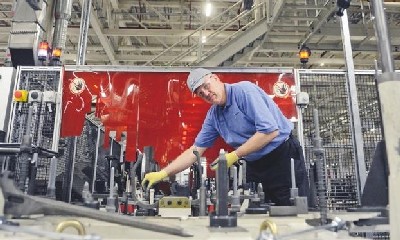
Working on the line at Volkswagen’s U.S. factory in Chattanooga, Tennessee gave me the chance to get answers to questions such as: How is VW is balancing environmental protection with its desire to significantly boost its vehicle sales and market share in the world’s second-largest market?
“We are paying painstaking attention to the correct handling of waste,” said Ilker Subasi, technical manager at the Chattanooga plant’s training center.
I immediately see how diligent VW is about disposing of waste in a green way. The factory does not have conventional trash cans so, after I have put on the protective cap and the buckle-less belt I must wear before starting work on the assembly line, I head over to the nearby recycling station to dispose of the wrapping.
I am assigned to the Powertrain section at the Pitch 1 workplace. The plant was officially launched in May 2011 to make the Passat for North America and is considered one of the most advanced vehicle assembly locations in the VW Group. It was awarded the U.S. Green Building Council’s seal of approval by reaching the platinum level, the highest level out of four categories.
One green highlight of the plant is an innovative paint shop where a waterless cover coat process will help VW conserve about 190 million liters of water in the next decade. In January of this year, VW began operating its own solar park, which is the largest in Tennessee. The solar collectors are spread over 26 hectares and generate up to 9.5 megawatts on sunny days, covering about 13 percent of the plant’s electricity needs.
Works starts at precisely 6 a.m. even though I had to undergo virtual training late into the night using the Vizendo teaching computer, a torture machine feared by trainees everywhere. “I have seen experienced guys break out in a sweat here,” the instructor said. “A number have lost a lot of weight in the process.”
My first jobs are to screw in pre-assembled front axles, mount tunnel bridges and attach bolts to mount the rear axle. And – for a bit of diversion – I get to mount the double-flow exhaust system for the Passat’s top model. At about 9 a.m., I feel the first twinge of pain in my back.
“If one of the mounting bolts doesn’t fit on the first try, then throw it in the red collection box,” advised Pitch 1 co-worker Brian Kjeldgaard. “The metal is completely recycled here.”
There is more: VW has the waste materials carefully sorted in the Passat production area. Next to the break table, there are containers for soft drink cans, waste plastic and paper. When it comes to environmental protection, success is the sum of small things. Large posters proclaim “Passion for detail” in many corners of the factory.
David Gustashaw, an energy specialist and one of the plant’s environmental representatives, is happy about the change in employees’ thinking. “We want to tie all employees into environmental protection, without exception,” he says.
After the long-awaited and far-too-short break, I chat with Douglas Evans, who wants to know what it’s like to drive on the German autobahn with no speed limit. The driving pace is rather leisurely on U.S. highways, so he could definitely imagine buying a slow but environmentally friendly “low-emission vehicle” as his next car. All the more since there are reserved parking spots for this type of vehicle and for car pools just outside the factory building. “From there, it would be just a few steps to the line,” Evans said.
What did I learn from my time on the line? People are living the sustainable life in Chattanooga, and building Passats is hard work. Beginners certainly earn their roughly $15 an hour. On that subject: I will donate my day’s wages for the beautification of the plant’s Emden conference room.
Yes, there really is a room at the VW facility in Chattanooga named after the main Passat plant in Ostfriesland, Germany. If someone were to buy soft cushions for the conference room’s chairs, who wouldn’t be happy to sit comfortably at the end of his shift?
If I had made a mistake while working on the line, my new friend at the training center, Ilker Subasi, probably would have been happy. When engines are declared defective due to transportation damage, he uses them internally for training purposes or donates them to interested universities. “We see this as environmental protection as well,” Subasi said. “We just do not tolerate the waste of valuable resources.”


