
Bosch, Daimler, BMW executives see opportunities for self-driving cars
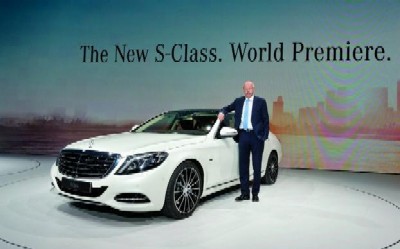
With its six eyes (cameras) and six ears (radar sensors), the new Mercedes S class can see and hear enough to drive itself at speeds up to 60kph (37mph). Daimler CEO Dieter Zetsche says the S class “marks the start of the era of partially autonomous driving.”
European automotive executives are bullish about the future of automated driving but they say it will take time for regulations to catch up with technology. They also say that no one wants to remove the fun of being behind the wheel.
Daimler CEO Dieter Zetsche stressed the second point during the world premiere of the Mercedes-Benz S class in May. He said the automaker’s flagship sedan “marks the start of the era of partially autonomous driving.” With its six “eyes” (cameras) and six “ears” (radar sensors), the S class can see and hear enough to drive itself at speeds up to 60kph (37mph), Zetsche said.
According to the CEO, the ultimate goal is to remove the boring parts of driving but keep the fun. “We will never automate the cool part of driving … the uncool part, though, we can do without,” he said during the car’s launch.
Wolf-Henning Scheider, who oversees Robert Bosch’s chassis systems unit, agrees with Zetsche’s assessment. “There are many situations where you have real fun driving and you want to drive. But there are also driving situations where you think you could use this time for other topics,” he said in an interview. “And if you take day-to-day commuting and traffic jam situations, we are convinced there is a market for automated driving functions.”
Although many of the pieces to achieve automated driving such as sensors that can control braking, steering, speed and the distance between vehicles are in place in models like the S class, BMW 7 series and Volvo XC60, Scheider says self-driving cars will not be a reality until they are proved “100 percent safe 100 percent of the time.”
He said to have fully automatic driving, the car needs redundant sensors. “We need at least two sensors to measure the same thing and then check between them. And there is certainly still some development necessary to have both in place; they are not ready.”
Another obstacle to overcome is making sure the system works flawlessly even when rain, snow or other elements reduce the car’s ability to see and hear. Scheider said that by using cloud computing, car-to-car infrastructure and different sensor principles, it is possible to overcome the hurdles created by weather and other factors. “But there are many other questions to be answered to bring a fully automatic driving car on the road,” he added.
Regulatory matter
BMW sales boss Ian Robertson said that the technology available today is “more than capable” to drive the car in many situations but regulation requires that drivers keep their hands on the wheel. “We’re in phase where technology has overtaken regulation, and the question is how quickly do the two align,” he said in an interview.
Government regulators are being cautious. A 2011 EU study on autonomous driving concluded that a number of key questions still need to be answered, such as:
• What effect does higher automation in the vehicle have on the driver?
• How to improve the driver interface without over loading them with information?
• How to achieve standardization for automated vehicle control and interface design without legislation?
• How to improve driver training for automated systems?
• Should the EU continue to allow a gradual migration of skill or introduce some form of universal training?
• How to integrate automated vehicles with other road users?
• Will other road users also require training?
5 years away?
Like their counterparts in the EU, regulators in the United States believe that self-driving cars could have huge benefits for drivers in the long run, but they should remain in the experimental phase for now. In the United States, Nevada, California and Florida have all passed laws allowing car companies such as Toyota and Audi to test self-driving cars on public roads. Several other states are considering following suit. The U.S. National Highway Traffic Safety Administration says it “has considerable concerns” about certain rules being drafted by states, and “does not recommend at this time that states permit operation of self-driving vehicles for purposes other than testing.”
The stance suggests that regulators will not allow these cars to be widely used within the next few years, even though some developers — such as the tech giant Google Inc., which is also working on the technology — have suggested that fully self-driving cars may be as little as five years away from the market.


