
Dr. Thomas Weber expects B-class EV to top BMW i3, others
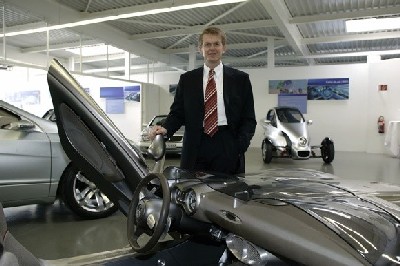
Daimler r&d chief Dr. Thomas Weber believes that the forthcoming Mercedes-Benz B-class Electric Drive will outpace the BMW i3 and other competitors in the fast-growing niche for battery-powered vehicles.
He also sees opportunities for Mercedes to expand the S-class range. Weber spoke with Matthias Krust, a reporter at Automobilwoche.
BMW launched its i3, a model developed from the ground up as an EV with a carbon skin. Daimler currently has only the electric Smart.
That will change next year when we bring out the full-electric B-class Electric Drive. In all the key criteria, this vehicle will be at least as competitive as our competitors’ models.
Why do you think this?
With the B class, we are bringing out an electric vehicle with five full-fledged seats and no constraints on trunk space. The B-class Electric Drive has a range of 200km – and that’s not just on paper. The 200km actually can be achieved in normal daily use. The car also has a top speed of 160kph. With torque of significantly more than 300 newton meters and with an acceleration of 0-100kph in 7.9 seconds, we are offering sports car feeling in a compact car. And the batteries are fully charged in three hours.
Won’t it be very expensive?
The price is not set, but we want to be extremely competitive here, too.
What Mercedes tech is in the car?
Two-stage energy recuperation is an important function that was developed by our engineers. And with the steering paddles, drivers can brake in two stages without having to operate the brakes with their feet. That offers an entirely new, very attractive driving experience.
Will you also sell the B class with a range-extending engine?
That is not currently planned. The hybrid concept is more efficient than a range extender. While I do not want to rule out offering models with range extenders in the future, as an engineer I don’t think much of workarounds. So I clearly prefer direct propulsion with an internal combustion engine for long distances.
What’s the launch plan for the B class?
The electric B class comes out first in the U.S. in the spring of 2014. Unlike Europe, there is a relatively significant demand for such vehicles. The B-class Electric Drive really has no predecessor in the U.S. It is being positioned in that market as a multipurpose vehicle and will only be offered as an electric model. Based on its design and the battery’s location, the car is somewhat elevated, and the 18-inch wheels add to its height. So the B class almost looks like a compact SUV.
When will the electric B class debut in Europe?
In autumn 2014 with the B class model upgrade, since we already have a much sought-after electric vehicle, the two-seat Smart ForTwo Electric Drive.
You appear ready to expand your range of S-class models.
That’s correct. With the short and long versions, we have two S-class models on the market. We displayed an attractive coupe as a show car at IAA. The concept car is already very close to series production. The market launch is planned for 2014. It’s also likely that we will derive a convertible from it. Then there will be an even larger version of the S class that we mainly need for China and the U.S.
At the IAA, Mercedes displayed the S 500 plug-in hybrid, which will reach the market next year. What does this vehicle mean to you?
We are very proud of this vehicle. With its plug-in hybrid drive, we are achieving fuel consumption of just 3 liters and CO2 emissions of 69 grams per kilometer. This is combined with outstanding driving characteristics as well as high-tech and luxury accessories. The S 500 plug-in hybrid has put to rest the entire debate about the sustainability of large cars, an issue that was raised a few years ago. We consider the comprehensive hybridization of our large model lines to be an important component of our powertrain strategy.
The wait time for the Smart ForTwo EV is more than nine months due to the slow ramp-up of the battery factory. Is the problem solved?
We have reached the point where we can ramp up capacity and cover the demand. At the same time, the Smart ForTwo Electric Drive has been very successful. With a share of 40 percent for the first half of 2013, it is a clear market leader among all newly registered electric cars in Germany.
Yet you are looking at all your options for your joint cell production in Kamenz, including a sale.
It is a matter of putting cell production on a long-term basis without any time pressure. At the same time, economies of scale are very important. That is why we are talking to practically every battery manufacturer, from Korea to Japan all the way to the U.S. We have plenty of time since the current battery technology for the Smart will be the basis for the next generation. Incidentally, I am very happy that we launched our own cell production with Evonik. It has given us more expertise than any other automaker.


